Material guide · 9 minute read
Granite — the kitchen workhorse.
Hard. Heat-tolerant. Cheaper than quartzite, more forgiving than marble. The stone that turned American kitchens from formica into stone in the 1990s, and the one most fabricators can install in their sleep.
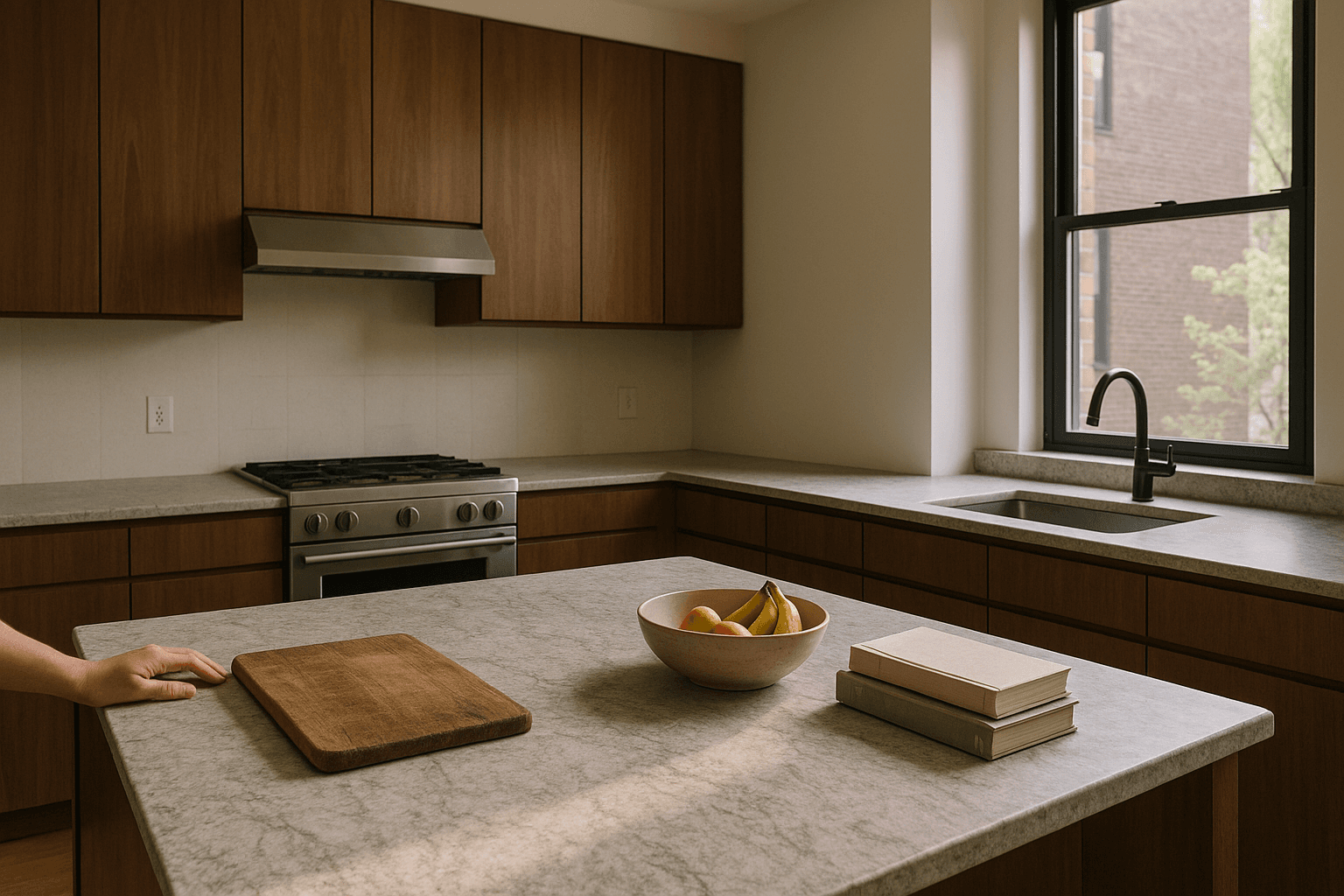
Granite is an igneous rock — magma cooled slowly underground over tens of millions of years. The result is a hard, dense, heterogeneous stone that resists scratching, etching, and heat. It’s been quarried at industrial scale since the 1980s and is the most common natural-stone counter material in North American homes by a significant margin.
- Mohs hardness
- 6.5
- Heat tolerance
- 1200°F
- Per square foot installed
- $70–$150
Just below quartzite, well above steel knives. Practically scratch-proof in normal kitchen use.
Hot pans straight off the burner are not a problem. Granite was the original work surface for blacksmiths.
20–40% cheaper than quartzite. Slightly more than mid-range marble.
[imagery brief: granite slab edge in fab shop]
What granite actually is.
Granite is an interlocking matrix of three minerals: quartz (the hard glassy chips), feldspar (the white or pink blocks), and mica or hornblende (the dark flecks). Pattern depends entirely on the lot. Two slabs labeled “Brazilian Black” from different lots will not match.
Because the mineral ratio varies, so does porosity. Lighter granites tend to be more porous and need more frequent sealing. Darker, denser granites can go years between seal applications.
“Granite asks for the least and gives you the most.”
— Lou D., third-generation fabricator
The case in real kitchens.
Granite is the only natural stone you can recommend without a daily-use disclaimer. Hot pans? No problem. Citrus? Fine. Red wine? Wipe and forget. Knife dropped on the edge? You’ll dent the knife before you chip the stone.
The trade-off is aesthetic, not functional. Granite reads “1990s stone” to a generation of buyers raised on marble lookalikes. The patterns are busy; the colors lean warm. Designers who want a quiet surface usually default to honed marble or quartzite. Designers building for daily use over decades reach for granite.
[imagery brief: granite kitchen install context]
Granite vs. its alternatives.
Granite
Igneous · workhorse
- Hardness
- Mohs 6.5
- Etches
- No
- Heat
- Up to 1200°F
- Sealing
- Annually (light); 3-yr (dark)
- Pattern
- Busy, heterogeneous
- Cost / sqft
- $70–$150
- Best for
- High-use kitchens, families, weekend cooks
Quartzite
Metamorphic · contemporary
- Hardness
- Mohs 7
- Etches
- No
- Heat
- Up to 1000°F
- Sealing
- Annually
- Pattern
- Soft veining
- Cost / sqft
- $110–$220
- Best for
- Modern kitchens, design-driven, premium budget
How to specify granite.
01
Decide light or dark
Light granites are more porous (more sealing). Dark granites are denser (less sealing). Both are equally hard.
02
Match lot to slab count
If your install needs more than one slab (a typical kitchen runs 2–3), insist on lot continuity. Different lots will not match.
03
See the actual slab
Granite varies dramatically within a single lot. Always pick the actual slab, not the showroom sample. Honed Earth listings include slab-level photos.
04
Confirm the seal coat
New installs ship with one factory seal. Year one needs a re-coat. Schedule it. The fabricator should include this in the quote.
A note on this
On radon and granite.
Public health research has examined whether granite countertops contribute meaningfully to indoor radon. The consensus from the EPA and major industry studies: residential granite emits radon at levels far below normal indoor background rates. There is no health-significant exposure from granite counters. The story circulates every few years; the data do not support concern.
“The lot is the lot. Granite doesn't lie about itself; the catalog does.”
— Marina K., kitchen designer
Lineage
A short history.
Antiquity
Egyptian builders quarry granite from Aswan for obelisks and column bases. The same quarries are still active today.
1850s
American railroads use granite for bridge piers; quarries open across New England and the Carolinas to keep up.
1980s
Diamond saw blades become affordable; Brazilian and Indian granite enters US residential at scale. Granite kitchens become a status marker.
2000s
Engineered quartz takes some of the residential market on uniform-pattern grounds. Real granite holds the high-use professional segment.
2026
Honed Earth lists every active granite supplier with lot-level photos. Showroom roulette ends.
Common questions
Will granite go out of style?
Pattern preferences cycle. The stone itself does not. A 1995 granite counter still functions perfectly; the new owner may simply re-fabricate the surface in a new finish or stick with what works.
How is granite different from quartz?
Quartz countertops are engineered — silica chips bound in resin (Caesarstone, Cambria, Silestone). Granite is natural metamorphic rock. Both are hard. Granite has more pattern variation and warmer color; quartz is more uniform.
Does granite need sealing?
Yes — but less than marble. Light granites annually; dense dark granites every 2–3 years. The sealer takes 15 minutes and costs about $40 in materials.
Can I cut directly on granite?
You can, but you shouldn't. The stone is harder than your knives, so the knives lose the fight. Use a cutting board to protect the knives.
Find granite that fits the kitchen.
Honed Earth lists granite from every active North American supplier. Filter by lot, finish, dimensions, and recent verification.