The case · 10 minute read
Why natural stone — the honest comparison.
Engineered alternatives — quartz, sintered, porcelain — solved the uniformity problem. They created two new ones. This is when natural still wins, when engineered is right, and how to tell.
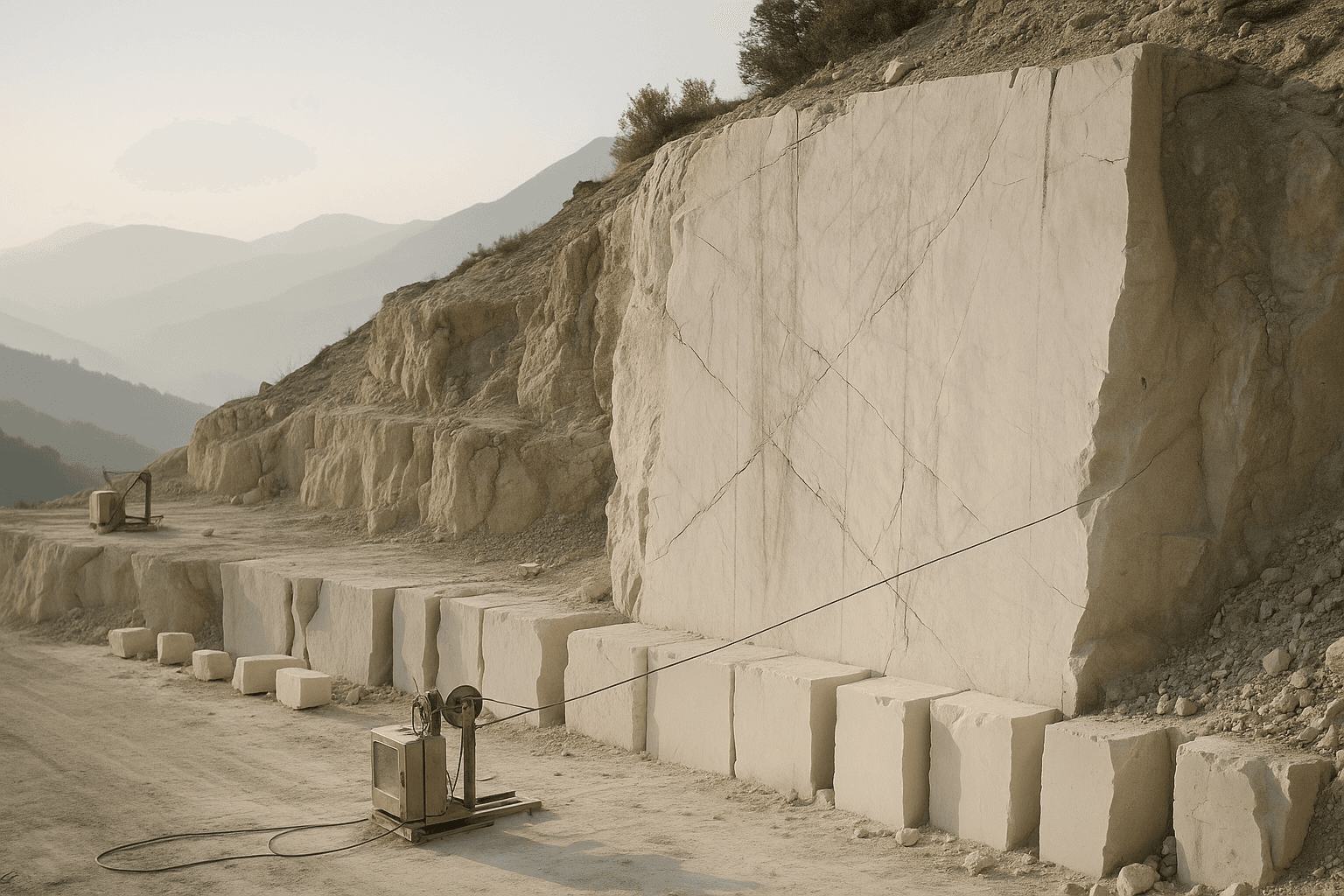
Engineered countertops are roughly 70% of new American kitchen installs in 2026. They’re uniform, scratch-resistant, and arrive without lot variation. They also cannot be repaired, generate substantially more waste at end-of-life, and develop their own failure modes — heat damage, resin breakdown, pattern fatigue — that natural stone doesn’t share.
- Natural stone life
- 60+ yr
- Engineered counter life
- 20–30 yr
- Repair-ability of engineered
- 0×
Carrara installed in 1955 still serves as Carrara installed in 1955. Patina is the only change.
Resin-bound surfaces yellow, heat-damage, or develop cracks from impact stress. Pattern dating is also a real factor.
Damage to engineered surfaces requires full replacement. Natural stone can be re-honed, re-polished, patched.
[imagery brief: aged natural stone counter]
What natural stone does.
Natural stone records its history. A scratch becomes part of the surface and weathers with age. An etch on marble becomes a patina mark. A crack can be filled and almost invisibly repaired by a fabricator. The same slab serves through three remodels.
Each lot is a unique mineralogical fingerprint. Identical reproduction isn’t possible. For some buyers that’s a problem; for most, it’s the point.
“Natural stone is the only counter material that gets better with use.”
— Marina K., kitchen designer
What engineered does.
Engineered surfaces solve the lot-variation problem. A specified pattern arrives identically across the country. The surface starts uniform and resists daily-use damage well in year one. For commercial settings where consistency across multiple installs matters, the case is strong.
The trade-offs: heat tolerance is dramatically lower (resin softens around 300°F), the surface cannot be repaired, and end-of-life produces a counter that goes to landfill rather than back to a fabricator’s remnant pile.
[imagery brief: engineered surface comparison]
Side by side.
Natural stone
Marble, granite, quartzite, soapstone
- Pattern variation
- Lot-specific
- Heat tolerance
- Excellent
- Repair-ability
- High — re-hone, patch, fill
- End of life
- Re-fabricable, recyclable
- Cost / sqft
- $70–$220 install
- Best for
- Long-life kitchens, design-driven, repair-friendly
Engineered (quartz)
Caesarstone, Cambria, Silestone
- Pattern variation
- Spec-uniform
- Heat tolerance
- Limited (resin softens)
- Repair-ability
- Low — replacement only
- End of life
- Landfill
- Cost / sqft
- $60–$140 install
- Best for
- Multi-unit consistency, low-maintenance, year-one perfection
How to choose.
01
Audit your kitchen
Daily cooking, hot pans, expected lifespan. Natural stone wins on durability and longevity. Engineered wins on first-year aesthetics and uniformity.
02
Account for repair
Natural stone is repaired in place. Engineered is replaced. Multi-decade kitchens are dramatically cheaper in stone.
03
Visit real installs
A 5-year-old natural stone install reads patina-rich; a 5-year-old engineered install reads tired. See both before specifying.
04
Match the budget honestly
If the budget is tight and the timeline is short, engineered makes sense. If the project deserves to outlive the renovation, stone is the cheaper material per decade.
A note on this
On silicosis.
Engineered quartz fabrication has been linked to severe silicosis in workers without adequate respiratory protection — Caesarstone-class materials produce significantly more crystalline silica dust during cutting than natural stone. This is a fabricator-side health concern, not a homeowner-side one. When specifying engineered, ask the fabricator about their dust control protocols. Honed Earth verifies fabricator certifications on request.
“The kitchen survives the renovation. The stone survives the kitchen.”
— Lou D., third-generation fabricator
Lineage
A short history.
Antiquity
Marble counters in Roman bath houses. Limestone cooking surfaces in Egypt. Soapstone in Norway. Natural stone has been the kitchen surface for millennia.
1950s
Formica and laminate enter American kitchens. Affordable, uniform, easy to install. Natural stone retreats to high-end remodels.
1990s
Granite returns at scale via Brazilian imports. Marble follows. Natural stone re-becomes residential.
2000s
Engineered quartz arrives — solves lot variation, capitalizes on uniformity. Captures the volume residential market.
2026
Natural stone reclaims share on durability and repair-ability stories. Honed Earth makes lot-level provenance visible to every buyer.
Common questions
Is natural stone really more sustainable than engineered?
Per square foot, slightly. Quarrying produces dust and CO₂; engineered manufacturing produces dust, CO₂, and resin waste. The substantial difference is end of life: natural stone gets re-fabricated into smaller pieces. Engineered goes to landfill.
What about porcelain or sintered slabs?
Porcelain (e.g., Dekton, Neolith) is fired at high temperature without resin. It's more durable than engineered quartz but still cannot be repaired. Heat-tolerant; impact-fragile at the edges. A different category.
Can engineered ever be the right call?
Yes — short-term flips, multi-unit projects requiring identical surfaces, or kitchens with unusually high color-uniformity requirements. The category exists because it solves real problems.
Where does Honed Earth fit?
We list natural stone only — marble, granite, quartzite, soapstone, travertine, onyx, limestone. The marketplace is the working surface for the trade. Engineered surfaces are sold by their manufacturers; we don't compete with that channel.
Browse real lots, with the trail.
Every Honed Earth listing carries lot, finish, dimensions, supplier, and audit history. The opposite of a showroom catalog.