Sourcing · 11 minute read
Sustainable sourcing — what it actually means.
The phrase ‘sustainable stone’ appears in every supplier brochure. Here’s what it ought to mean: low-transport carbon, regulated quarry practices, end-of-life re-use. Plus how to actually verify any of it.
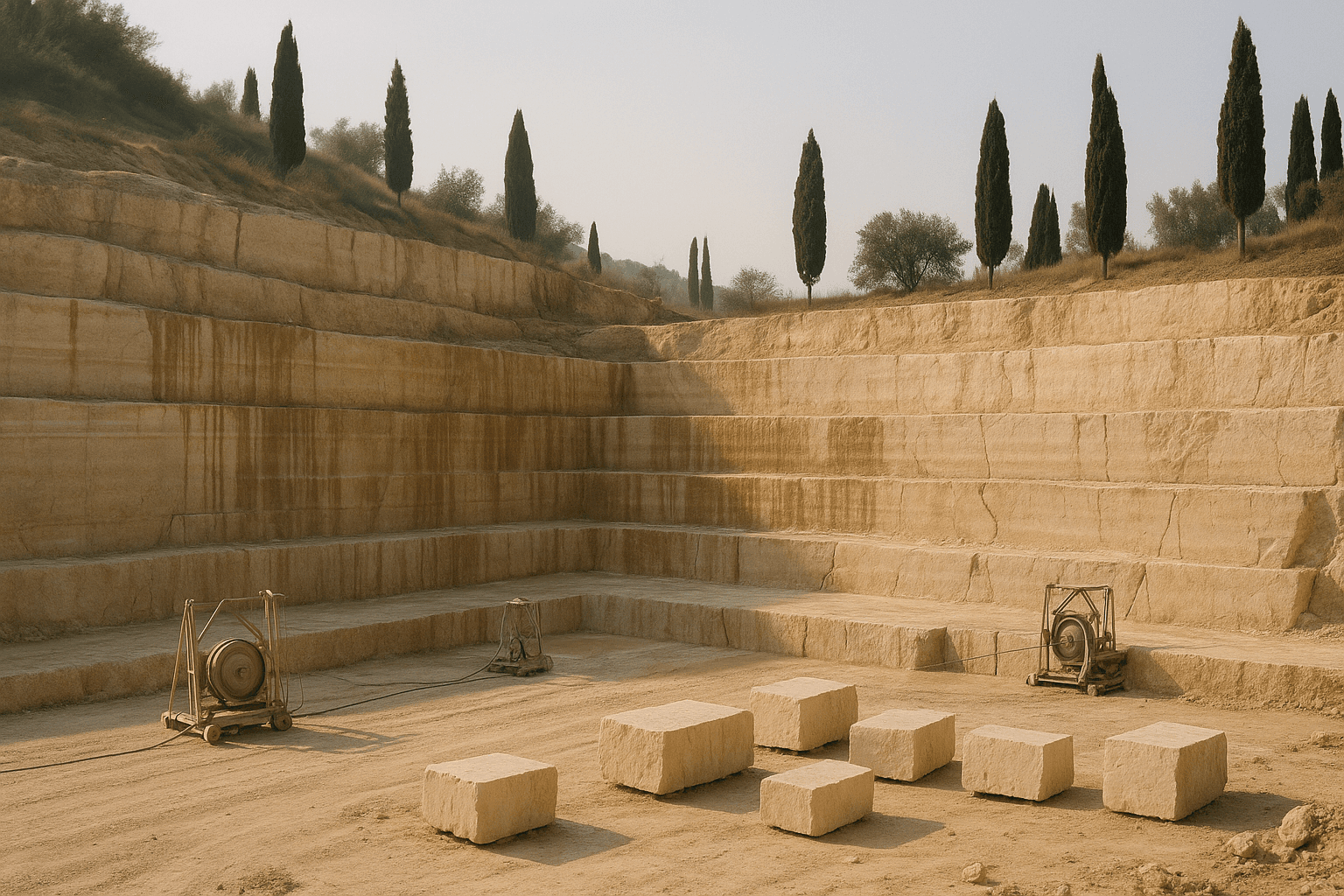
Stone is the lowest-embedded-carbon counter material per square foot — natural mineralogy, no resin, no firing. The footprint is dominated by transport (quarries are far from kitchens) and quarry practices (water reclamation, dust capture, working conditions). The good news: every link in the chain is auditable. The hard part is getting the audit.
- Per kg quarried stone
- 0.4 kgCO₂
- Of footprint = transport
- 60–70%
- End of life
- 100% remnant re-usable
Roughly half the embedded carbon of engineered quartz, one tenth of porcelain.
Italian marble shipping to Brooklyn embeds far more carbon in trucks and ships than in quarry operations.
Cut-offs become tile, bath surrounds, fireplace hearths. Honed Earth lists remnants alongside slabs.
[imagery brief: quarry-site working photo]
What responsible quarrying looks like.
Modern quarry operations differ enormously from the romantic image. Diamond-wire saws, water-recirculation systems, dust-capture filtration, and worker safety standards (ILO, EU Directive 2009/104) define the modern professional quarry.
Reputable suppliers publish their practice statements. Honed Earth lists supplier certifications and audit dates as part of the supplier profile — not buried in a PDF.
“The stone is sustainable. The supply chain is the question.”
— David Timarchi
Why remnants matter.
Every fabricated countertop produces 15–30% offcut. Historically that material went to landfill. Modern fabrication shops keep a remnant pile — pieces big enough for bath vanities, fireplace hearths, kitchen islands in tiny apartments.
HE lists remnants as first-class inventory. Same audit trail, same supplier accountability. Buying a remnant for the right project is the most sustainable specification you can make.
[imagery brief: cut-off remnant repurposed]
Domestic vs. imported sourcing.
Domestic
US, Canada, Mexico
- Transport carbon
- Low (truck only)
- Variety
- Limited
- Granite
- Vermont, Georgia, Texas
- Marble
- Vermont (Danby), Colorado
- Lead time
- 1–2 weeks
- Best for
- Carbon-sensitive specs, fast lead times
Imported
Italy, Brazil, India, Norway
- Transport carbon
- Higher (sea + truck)
- Variety
- Vast
- Granite
- Brazilian Black, Indian Star
- Marble
- Carrara, Calacatta, Statuario
- Lead time
- 8–12 weeks
- Best for
- Specific aesthetics, signature projects
How to source responsibly.
01
Ask for the lot trail
Where was it quarried? When was it shipped? Who's the importer of record? Honed Earth listings carry this; older sourcing channels often don't.
02
Consider domestic first
For pure carbon math, Vermont marble beats Carrara every time. The aesthetic difference is real but smaller than people assume.
03
Specify remnants where possible
Half the embedded carbon, less than half the price, same audit trail. Remnants are listed as their own inventory class.
04
Verify the supplier's certifications
ILO labor standards, EU Directive compliance, water-recirculation evidence. Reputable suppliers publish these. Honed Earth surfaces them.
A note on this
On ‘ethical’ certifications.
There is no single industry-wide certification for ‘ethical stone’ the way there is for fair-trade coffee. Various national programs (Italian Marble Trade Association, Brazilian Apex-Brasil) offer audited certifications. Be wary of unbranded ‘eco’ or ‘green’ labels with no third-party verification — they are the marketing version of greenwashing. The audit trail is what matters.
“The most sustainable kitchen is the one whose counter survives three remodels.”
— Marina K., kitchen designer
Lineage
A short history.
Antiquity
Stone quarried locally because transport across mountains was expensive. Most kitchens used what came from within a day's cart.
1900s
Industrial transport (rail, then ship) makes global stone trade economical. Carrara starts shipping to North America.
1990s
Containerization halves the per-slab transport carbon of imported stone. Brazilian granite reaches mass-residential viability.
2010s
Sustainability frameworks (LEED, BREEAM) start specifying low-carbon counter materials. Engineered surfaces market themselves as sustainable; the math is mixed.
2026
Honed Earth ships listing-level provenance + supplier certifications as a first-class platform feature. Sustainable sourcing becomes auditable.
Common questions
Is engineered stone really worse for the environment?
Per square foot, modestly worse on embedded carbon. Significantly worse on end-of-life — engineered surfaces cannot be re-fabricated and go to landfill. The biggest factor is replacement cycle: engineered surfaces typically replace at 20–25 years; natural stone lasts 60+.
What about transportation carbon for imported stone?
Real but smaller than people assume. Sea transport at scale is energy-efficient. Trucking the last 200 miles from port to fab shop is the larger contributor. Domestic sources beat imports on this dimension.
Are remnants the same quality?
Yes — they're cut from the same slabs. The constraint is size. A remnant that fits a bathroom vanity is fine; one that needs to span a kitchen island isn't.
Where does Honed Earth fit in?
We surface the audit trail. Lot numbers, supplier certifications, transport records, end-of-life options. We don't certify sustainability; we make the evidence accessible.
Source the next slab with the trail intact.
Every Honed Earth listing includes lot, supplier, certification, and audit history.